
The Religious Organization's View on Bungeishunju's Publication 'I Grew Up in a House with a 'God' ~ We, the Second Generation of Religion ~'
(Last Update: )
The fifth episode included in the manga 'I Grew Up in a House with a 'God' ~ We, the Second Generation of Religion ~' (authored by Mariko Kikuchi), published by Bungeishunju, seems to depict Happy Science, but it contains many factual inaccuracies and unjust depictions of the objects of faith and doctrines, which significantly harm the faith of the organization's believers.
Bungeishunju and Mariko Kikuchi, who effectively acknowledged the factual inaccuracies in the Shueisha version of the manga
This manga was serialized on Shueisha's website 'Yomitai' in February this year and later published as a book by Bungeishunju. During this process, many factual inaccuracies present in the Shueisha version were deleted or corrected. For example, the passage 'If you are caught dating, you will be locked in a small room with a key' was deleted, and in the passage 'There was also an altar in the house that cost about 3 million yen,' the amount was deleted. Additionally, scenes that slander without specific points, such as 'doctrines full of flaws,' were also deleted. This indicates that Bungeishunju and Mariko Kikuchi effectively acknowledged the factual inaccuracies in the Shueisha version of the manga.
Numerous clear factual inaccuracies in the manga
The main clear factual inaccuracies in the manga are as follows.
1. 'If you don't attend the night prayer or break the curfew, you will have to listen endlessly to the founder's sermons in a small room.'
→ There is no such fact. If you don't attend the night prayer or are late for the curfew, at most, you will receive a verbal warning.
2. 'The president is also recommended to go to the University of Tokyo.'
→ There is no such fact.
3. 'In the mountains, it takes an hour by bus and train to the city center.'
→ It takes 30 minutes by bus to the nearest city center.
4. 'About two periods of religious time per week.'
→ It is one period per week. Also, private schools are legally allowed to substitute moral education time with religious time.
5. 'A house like a castle.'
→ It is not a house but a religious facility for communicating with the spiritual upper world, supported by many clergy performing sacred duties.
6. 'Made unable to do anything.'
→ There are no such restrictions, and various career choices are made at each individual's discretion. Among the over a thousand graduates, some have become staff of the organization, while many have found employment in general companies and are active in various fields.
7. 'Told to work for the organization after graduating from university.'
→ We do not teach such things.
The protagonist who cuts off contact with worried family, teachers, and friends
Additionally, the manga depicts 'It was discovered that my mother had incurred a large debt in my name.' This seems to refer to a scholarship, but scholarships can only be borrowed in the person's name. In the case of this manga, in reality, the mother has been repaying all the scholarships from the beginning.
Admission to the academy's high school was the individual's will, and during their time at the academy, they actively participated in club activities and went on to a general university after graduation. Ten years have passed since graduation, and the individual has cut off contact with worried family, teachers, and friends.
At the beginning of the manga, there is a scene where the protagonist, at 24 years old, attempts suicide by overdosing on drugs, but our group repeatedly teaches that 'you must not commit suicide.' Humans are given 'eternal life' as children of God, and the materialistic and atheistic view that 'everything disappears when you die' is wrong.
It does not mean that it is acceptable to irresponsibly harm precious faith
Additionally, the manga author, Mariko Kikuchi, is a second-generation former Soka Gakkai member, and it seems that the 'anti-other-religion' ideology seen in some Nichiren sects is strongly reflected. Kikuchi stated in a tweet about the manga, 'If you are bound by things like not hurting, fairness, neutrality, and presenting both sides, the second-generation issue will not even be brought to the table,' but this is an irresponsible statement acknowledging the low truthfulness of her manga. Since it deals with an existing religious organization, it does not mean that it is acceptable to harm the 'precious faith' of many believers.
Biased works on religion are 'human rights issues'
President Ryuho Okawa is the 'object of faith' of our organization, to which many believers dedicate their precious faith. The manga contains many depictions that hurt the faith feelings of the organization's believers. For example, a character who clearly resembles the organization's president is depicted with the line 'Made into the first batch of the religious academy,' as if he is the cause of the protagonist's misfortune. However, in reality, most academy graduates believe that by having faith, they have gained a stable and peaceful mind along with an unwavering view of life and have 'become happy.' Depictions that distort facts like in this manga, or introducing only a very few biased and one-sided negative opinions, foster aversion to that religion and 'religious discrimination,' which itself is a 'human rights issue' that troubles the children of families with faith.
Hiroshi, who pretends to be knowledgeable about internal affairs and makes false statements
Additionally, the manga states, 'The founder's eldest son has started exposing the internal affairs of the organization.' However, Hiroshi is only pretending to be knowledgeable about the internal affairs of our organization and making false statements. In fact, in the court cases concerning YouTube videos filed by our organization and the book 'Separation from Happy Science' published by Bungeishunju, many of Hiroshi's falsehoods were recognized, and he was ordered to pay damages and delete related videos, with our group winning the case (Tokyo District Court January 21, 2022, ruling, Tokyo District Court March 4, same year, ruling). Furthermore, in the appeal ruling concerning the YouTube video case, the Tokyo High Court recognized defamation in parts not acknowledged in the first trial, pointed out Hiroshi's unrepentant attitude as 'malicious,' increased the damages by 70%, and ordered the deletion of the videos (Tokyo High Court September 29, same year, ruling). In these rulings, not a single point of Hiroshi's claims was recognized as true.
Bungeishunju lacks conscience
Shueisha, which decided to stop the publication of the manga, stated as the reason, 'It cannot be denied that it hurt the believers of specific religions or organizations and their faith,' and 'We take this seriously and apologize,' responding sincerely based on the publisher's conscience. However, this time, Bungeishunju published the book without conducting any fact-checking interviews with our group, leaving many factual inaccuracies. Freedom of speech and publication is based on the premise that market participants have conscience and common sense, but it must be said that Bungeishunju lacks conscience.
Bungeishunju published a malicious manga work aiming to damage the image of our organization through false impression manipulation, hurting the precious faith of many people. The company should first reflect on itself, fully recognize the weight of this responsibility, and sincerely face 'what is correct reporting.'
 Happy Science Academy Nasu Main School Official Channel


 Happy Science Academy Kansai Junior and Senior High School Public Relations Channel


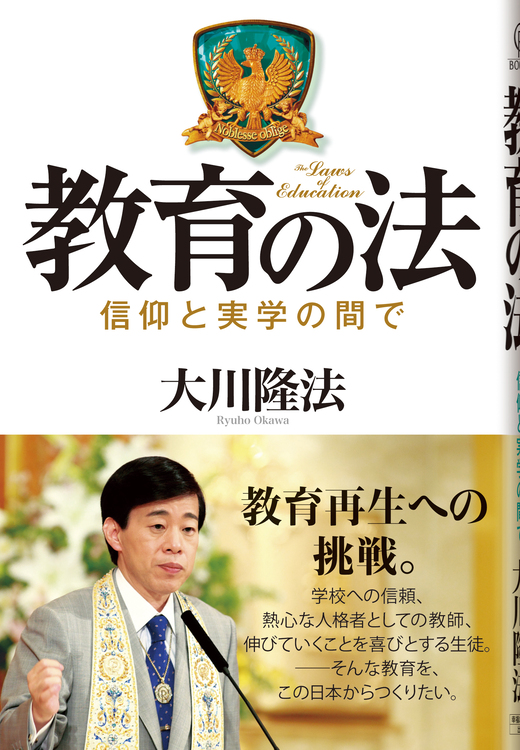
'The Laws of Education' Between Faith and Practical Learning
From specific measures and solutions to serious bullying problems, the way teachers can regain trust in schools, and how to produce future leaders through religious education and entrepreneurial spirit. This book is packed with hints to solve all educational problems and practice ideal education. 'Education has many complex problems. However, if you get to the bottom of it, it's about trust in schools, teachers as passionate individuals, and students who find joy in growing. - That may be all there is.' (From the 'Preface')

The Laws of Life: To Live a True Life
In an era where life is undervalued, this book elucidates its meaning and value head-on. Chapter 3, 'On School Education and the Freedom of Demons,' points out the spiritual issues behind the serious bullying problem, revealing the starting point of Happy Science's educational endeavors. Additionally, Chapter 4, 'On the Education of the Soul,' discusses 'soul education' that goes beyond moral education.
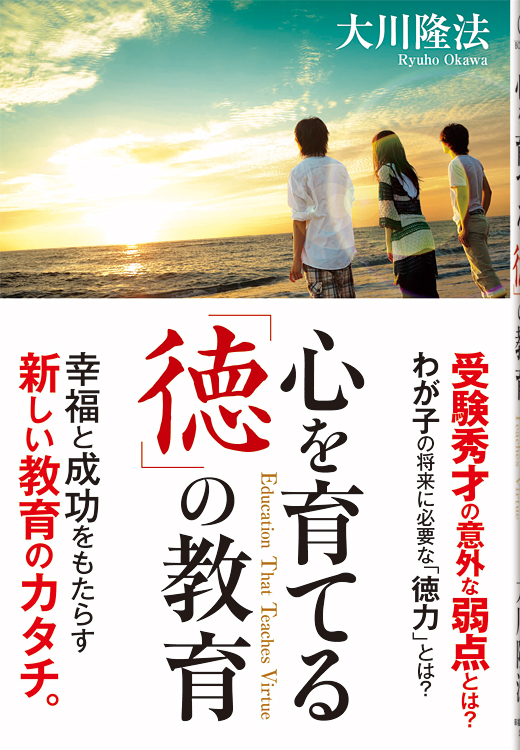
The Education of 'Virtue' that Cultivates the Heart
This moral education theory explains that controlling the mind to be of service to many people is the 'royal road to success.' It elucidates the origins, evolution, and issues of Japan's academic credentialism that began in the Meiji era, and highlights the importance of 'the power to create new values' and self-control in today's uncertain times.
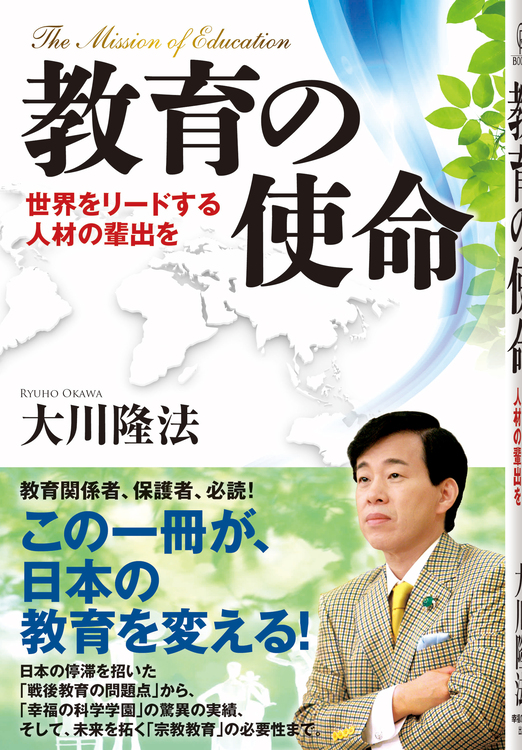
The Mission of Education: Producing Leaders for the World
A book summarizing the educational philosophy and practical theory of Happy Science Academy. It corrects the errors of post-war leftist education and biased historical views, presenting an educational theory that transforms Japan into a nation leading the world through 'the spirit of self-help,' 'entrepreneurial mindset,' and 'religious education.'
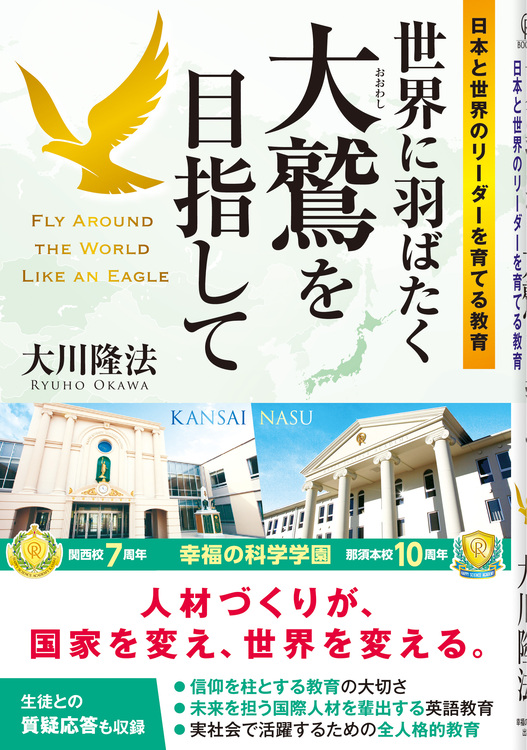
Aiming for the Great Eagle Soaring in the World: Educating Leaders for Japan and the World
A book compiling the teachings and Q&A sessions conducted by the author, the founder of the academy, with students. It reveals the author's wish to nurture new era leaders active in the international community, which has manifested in remarkable achievements in both academics and extracurricular activities within just a few years of the academy's founding.
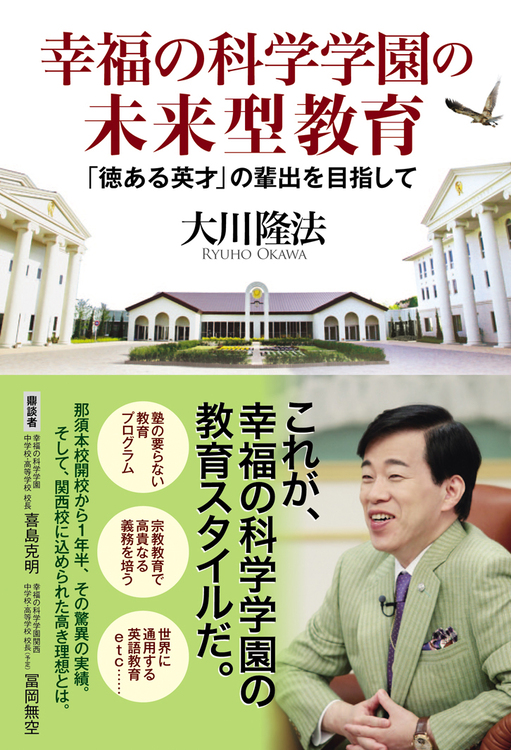
The Future-Oriented Education of Happy Science Academy: Aiming to Produce 'Virtuous Talents'
A compilation of a dialogue between the author, the founder of the academy, and the principals of the Nasu and Kansai campuses. It provides insights into the educational philosophy embedded in the academy's endeavors, the daily lives of the students, the ideals of English and science education, and the significance of religious education.
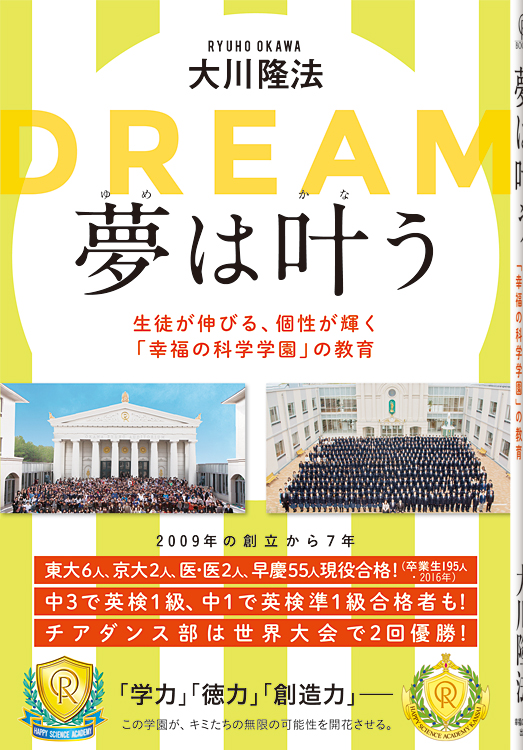
Dreams Come True: The Education of Happy Science Academy Where Students Grow and Individuality Shines
A book based on the lectures given by the author, the founder of the academy, to the students. It discusses an educational approach that polishes the heart based on religion, enhances academic ability without relying on cram schools, nurtures 'moral power' while honing talents, and develops English proficiency to thrive in the international community, thereby unlocking the infinite potential of students.

Aiming to Be True Elites: No Genius Surpasses Effort
A book that plainly discusses the mindset necessary to become a true elite who fulfills 'noble obligations' to society through academic training of the heart. It emphasizes the importance of not deceiving oneself in studies, the habituation of 'guts,' 'perseverance,' 'passion,' and 'continuity,' and the cultivation of a beautiful heart of 'gratitude and repayment.'


You may also like


PICK UP
 ログインが必要 … 閲覧には
 入会者限定 … 幸福の科学の会員のみ閲覧が可能です。
 三帰誓願者限定 … 幸福の科学の三帰誓願者のみ閲覧が可能です。
  植福の会参加者向け …
  大黒天信者向け