
Weekly Shincho, which cannot distinguish between cults and faith, should know that it has no "qualification to discuss religion."
(Last Update: )
The special issue of "Weekly Shincho" (8/25 issue) is slandering noble faith by treating the problematic cult that caused anti-social incidents and Happy Science as equals. They, who lack significant insight, should know that they have no qualification to discuss religion in the first place.
Weekly Shincho's ignorance regarding the "Friday Incident"
In the problematic article, under the headline "The Cradle of Cult Religions in the Decline of the Late Showa Era," problematic cults that caused terrorist and fraud incidents, such as Aum Shinrikyo and Ho no Hana, are listed, and Happy Science is mentioned as if it were of the same kind.
However, the "Friday Incident" cited as "an incident caused by our association" was actually an incident where Friday, published by Kodansha, repeatedly published baseless defamatory articles, and our association was merely in the position of a "victim." By courageously protesting against Friday, which continued to slander sacred faith under the pretext of "culture follows if it sells," and openly criticizing its unethical commercialism, a check was finally placed on the excessive "violence of speech." The incident was a turning point in post-war cultural history where a serious scalpel was applied to the de facto first power, the "media power," and its tyranny, and it was also the moment when the backbone of "God's justice" was instilled in the values of our country, which had been adrift since the post-war period.
Weekly Shincho seems desperate to equate Happy Science with problematic cults, but the more they repeat such petty tricks, the more their ignorance stands out.
Weekly Shincho, which cannot distinguish between "bubble" and prosperity
The article also points out that the religious boom since the 1980s is a product of the decline of the bubble at the end of the Showa era, and that "the spread of capitalist freedom and competition induced the expansion of selfishness and the theory of self-responsibility, causing empathy for particularly vulnerable people to recede."
However, dismissing the economic boom at the end of the Showa era as "the decline of the bubble" is an insult to the post-war Japanese who rose from the devastation after the war and worked hard for the reconstruction and prosperity of our country. It is a fair view to think that it was precisely because our country persevered through the security struggle and remained in "capitalist freedom and competition" that high economic growth was achieved, and employment opportunities were opened even to those who would otherwise have had to remain in a "weak position," allowing the entire society to enjoy "equality of prosperity."
Furthermore, the fact that our country began to seriously walk the path of becoming a superpower alongside the United States from the late 1980s, at the end of the Cold War, underpins the legitimacy of the Greater East Asia War, which was fought with the banner of abolishing racism. Nevertheless, focusing only on the negative aspects of "the expansion of selfishness and the theory of self-responsibility" is nothing but a misunderstanding of the mechanisms of international political economy and a leftist self-deprecating historical view.
Reflect on prejudice and outdated perceptions of religious activities
It is also a prejudiced and outdated view to think that the religious groups that grew during this period are still based on a "special sense of solidarity isolated from general society."
The article cites that "creating a special sense of solidarity isolated from general society effectively works when bringing in people who cannot find a place as social bonds weaken" as a reason for the growth of each religious group.
However, religious activities that save souls are the greatest social contribution and public welfare activity for religion. In that sense, beyond religious ceremonies and events that are accepted in general society, building deep and unwavering spiritual trust among believers and bonds with the noble Buddhas and gods of the invisible world is the original mission of religion.
In our association, for example, we are accelerating efforts to extend a helping hand in every possible way, both materially and spiritually, to those suffering from poverty, disasters, disabilities, and mental illness, starting with group activities to spread a concrete utopia. We are engaged in various charities, including support for the reconstruction of the Great East Japan Earthquake, operating schools for children who refuse to attend school, suicide prevention activities, support for people with disabilities, and supporting a general foundation tackling bullying issues. Internationally, we are involved in school construction, donation of educational materials, and donation of clothing and goods in countries such as Nepal, India, Malaysia, Uganda, the Gaza Strip, Sri Lanka, and Myanmar.
The article emphasizes that joining a religious group is tantamount to "isolating from society," but this is a big mistake. Religious groups have a vertical relationship with the founder at the top, as well as a horizontal relationship where solidarity and salvation functions among believers are exercised. Over the years, as our association has grown into a large religious group, it has developed into a salvation-type religion with strong horizontal solidarity, in addition to the initial movement where each person sought spiritual growth.
Judging based solely on decades-old knowledge and the fragmented peeping of freelance writers who call themselves journalists, without conducting fair interviews or investigations as appropriate, is nothing but a prejudice that distorts the real image. Weekly Shincho, which is entrenched in jealousy and prejudice against religion, should know that "correct values" are indispensable behind speech, and ultimately, there is a "value judgment for the era bestowed by gods and Buddhas." They should strive for proper interviews by individuals equipped with religious common sense and education.
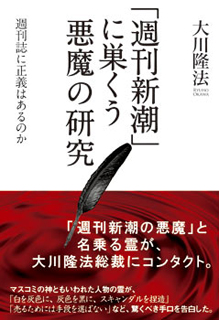
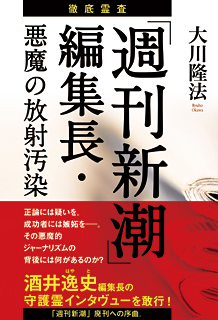
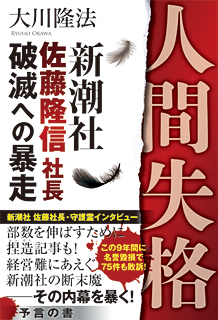
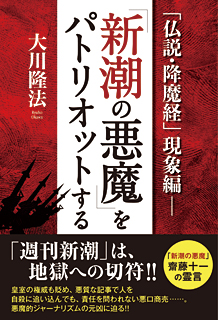
※ Regarding Weekly Shincho, 'Research on the Demon Nesting in "Weekly Shincho"' 'Editor-in-Chief of "Weekly Shincho" - The Demon of Radioactive Contamination' 'No Longer Human: Shinchosha President Takashi Sato's Runaway to Ruin' 'Buddhist Sutra: The Phenomenon Edition of the Demon of Shincho - Patriotism' (published by Happy Science Publishing) have been published.
Happy Science Group Public Relations Division


You may also like


PICK UP

 ログインが必要 … 閲覧には
 入会者限定 … 幸福の科学の会員のみ閲覧が可能です。
 三帰誓願者限定 … 幸福の科学の三帰誓願者のみ閲覧が可能です。
  植福の会参加者向け …
  大黒天信者向け